Fulfilled In You?
By Olivia Carlé
Fulfilled In... You?

The Bible
I remember reading Gordon Fee & Douglas Stuart's book "How to Read the Bible For All Its Worth" - an excellent book. They emphasised that we should take note of certain things when reading the Scriptures:
The historical context, which will differ from book to book, ...the time and culture of the author and audience, that is, the geographical, topographical, and political factors that are relevant to the author’s setting.
The... literary context means first that words only have meaning in sentences, and second that biblical sentences for the most part have full and clear meaning only in relation to preceding and succeeding sentences.
The most important contextual question you will ever ask — and it must be asked over and over of every sentence and every paragraph — is:
What’s the point? We must try to trace the author’s train of thought. What is the author saying, and why does he say it right here?

Over the years I have read and have heard people read Psalm 91...
1 One who dwells in the shelter of the Most High will rest in the shadow of the Almighty.
2 I will say to the Lord, “My refuge and my fortress, my God, in whom I trust!”
3 For it is He who rescues you from the net of the trapper and from the deadly plague.
4 He will cover you with His feathers, and under His wings you may take refuge; His faithfulness is a shield and wall.
5 You will not be afraid of the terror by night, or of the arrow that flies by day;
6 Of the plague that stalks in darkness, or of the destruction that devastates at noon.
7 A thousand may fall at your side and ten thousand at your right hand, but it shall not approach you.
8 You will only look on with your eyes and see the punishment of the wicked.
9 For you have made the Lord, my refuge, the Most High, your dwelling place.
10 No evil will happen to you, nor will any plague come near your tent.
11 For He will give His angels orders concerning you, to protect you in all your ways.
12 On their hands they will lift you up, so that you do not strike your foot against a stone.
13 You will walk upon the lion and cobra, you will trample the young lion and the serpent.
14 “Because he has loved Me, I will save him; I will set him securely on high, because he has known My name.
15 He will call upon Me, and I will answer him; I will be with him in trouble; I will rescue him and honor him.
16 I will satisfy him with a long life, and show him My salvation.”
It was a puzzle for me. I know that we can apply Scripture to our lives and claim truths from it as a guide but reading the verses I had to admit that verses 3, 6, 7, 10, 13, 16 were difficult. What about those who are martyred, those who are ill, those attacked by wild beasts, or those who die young?
But I accepted the Psalm as being true, because "God is not a man that He should lie to us"1- I just didn't understand how it was being fulfilled. Then a few months ago we were having a meeting with a few friends and we started by reading this Psalm and then like a beautiful wave of adrenalin, I saw it!
When Jesus was in the wilderness, the devil was trying to test Him by various temptations.2 The devil took Jesus to the pinnacle of the temple and taunted Him to throw Himself off saying that God would always save Him, and he quoted this verse from Psalm 91 to Jesus as proof.
11 For He will give His angels orders concerning you, to protect you in all your ways.
12 On their hands they will lift you up, so that you do not strike your foot against a stone.
Then it dawned on me that this was purely a Messianic Psalm, just like Psalms 2 & 22.
Psalm 91 is a glimpse of Jesus' spiritual walk in His earthly life. A divine man, filled with the Spirit and led by Him. By this Psalm we get a further view into Jesus' life and His relationship with the Father.
Verses 1-2, 4, 9, 14-15: Jesus said that He followed God's lead in everything saying He did nothing from His own initiative but only did what He saw the father doing.3
Verses 3, 6-10: Jesus never got sick. He touched the diseased afflicted with leprosy, fevers - transmittable diseases never hurt Him.4
Verses 5, 13: They tried to kill him, but couldn't do it.5
Verses 11-12: No accidents, no interference, no stopping His plan on the earth.6
Now, how do we interpret verse 16?16
I will satisfy him with a long life, and show him My salvation.”
He lived till He was thirty-three and they killed Him. This verse may seem a little tricky until we pull right back to view the whole image.
The reason Jesus came to this earth was to take the judgement of God for our sin. This was His purpose. A role He took on willingly. For it NOT to happen would have meant that He failed in His work. So this is not a verse that we can point to that He didn't live a long life but within the great plan, this was right because Jesus didn't stay dead. When He rose from the dead He had a better body than the one before. This resurrected body could pass through closed doors7- He was not a spirit because He ate food8 He could appear and disappear9 by His will. He lives forevermore - now that's long life.
Last Thoughts
There is a quote by Rudy Ruettiger that has been with me for years, he said:
I have learned two things, there is a God, and I am not Him

Not everything in Scripture was written with you in mind. Not everything in Scripture is for you. You are not the centre of Scripture - God is. This is a hard statement for some who are always wanting an "application for daily life".
Jesus Christ is God come with flesh and bones who now rules in a resurrected glorified body, who fulfilled everything for redemption that we couldn't. When Jesus spoke to the two disciples on the road to Emmaus after the resurrection, look where He began:
Then beginning with Moses and with all the Prophets, He explained to them the things written about Himself in all the Scriptures.
Jesus is all through the Old Testament - do you see Him there as you read? The Old Testament is like the foundation which the house (the New Testament) is built on. Jesus didn't pull scripture willy-nilly out of the blue but He carefully chose to speak them out because of the weight they carried. We too must see Christ in all the Scriptures and not just look for how it applies to us.
It's true that Romans 8:29 says:
"For those God foreknew he also predestined to be conformed to the image of his Son" but Christ is the centre:
For He rescued us from the domain of darkness, and transferred us to the kingdom of His beloved Son, in whom we have redemption, the forgiveness of sins. He is the image of the invisible God, the firstborn of all creation: for by Him all things were created, both in the heavens and on earth, visible and invisible, whether thrones, or dominions, or rulers, or authorities - all things have been created through Him and for Him. He is before all things, and in Him all things hold together.10
We must never forget that Christ is the central figure of all that God has done. Look for Him, beginning with Moses and with all the Prophets, and see how He is in all the Scriptures!
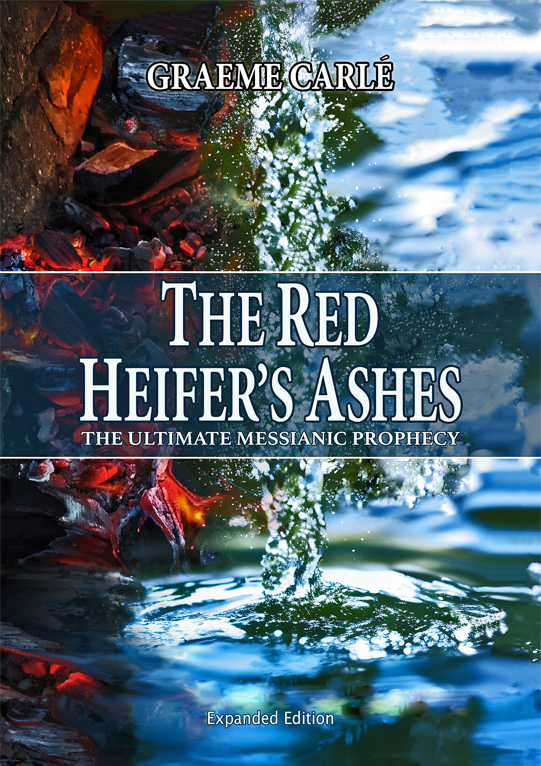
Graeme has written an excellent book looking at some of the rituals pointing to Jesus in the Old Testament:
The Red Heifer's Ashes